
Summary
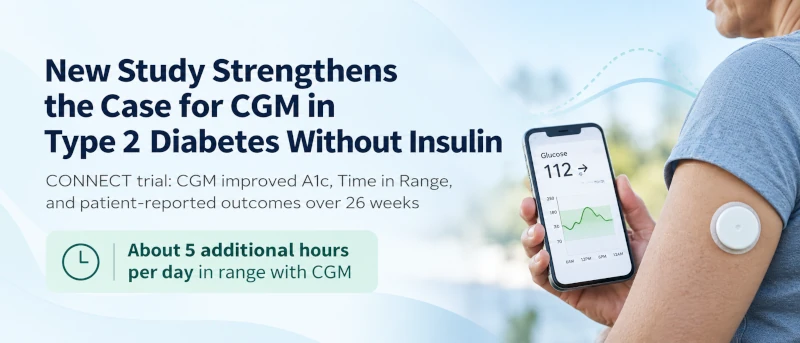
A randomized clinical trial published in The New England Journal of Medicine found that continuous glucose monitoring (CGM) significantly improved glucose management in adults with type 2 diabetes who weren't using insulin. The 26-week CONNECT trial demonstrated greater reductions in A1c, more time within the target glucose range, and improved satisfaction with glucose monitoring compared with routine care. The findings strengthen the evidence supporting broader CGM access and highlight the value of continuous glucose information in everyday diabetes management.
Key Points
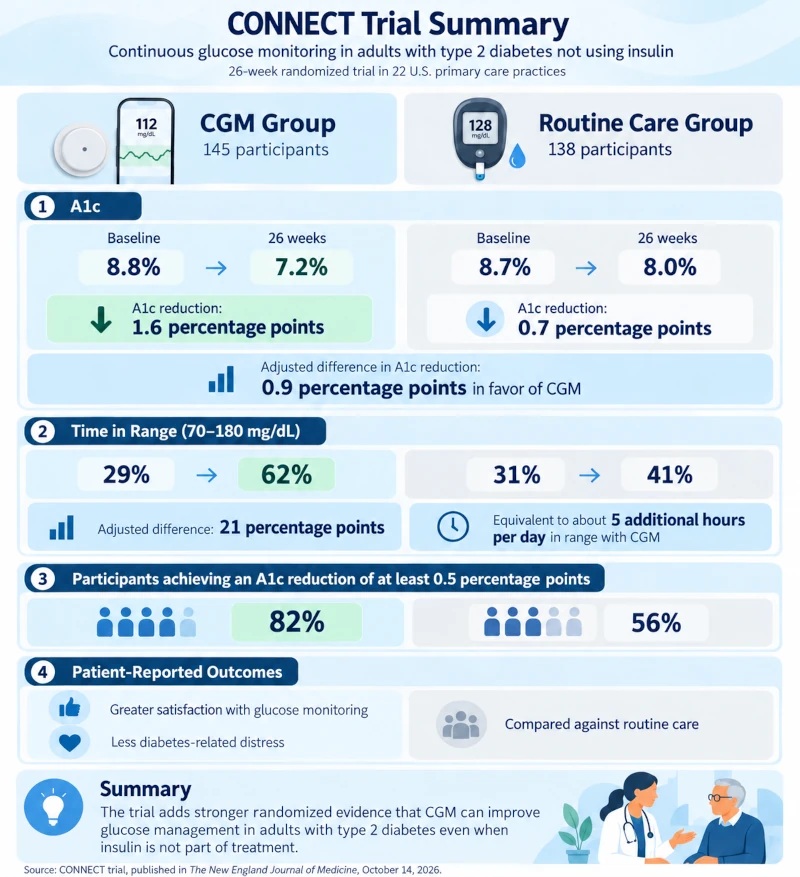
- Greater A1c reductions: Participants using CGM experienced an average A1c reduction of 1.6 percentage points, compared with 0.7 percentage points in the routine care group.
- More Time in Range: CGM users spent approximately five additional hours per day within the 70–180 mg/dL target range compared with routine care participants.
- Benefits beyond insulin therapy: Improvements were observed among adults not using insulin, including those taking GLP-1-based medications and SGLT2 inhibitors.
- Improved patient experience: Participants using CGM reported greater satisfaction with glucose monitoring and less diabetes-related distress.
- Stronger evidence for broader access: The findings support reconsidering CGM coverage limitations while highlighting the importance of access to features that help people recognize and respond to changing glucose levels.
New Evidence for a Broader Role for CGM
For millions of people with type 2 diabetes who don't use insulin, access to continuous glucose monitoring (CGM) remains limited, even though the technology can provide valuable insights into everyday glucose patterns.
New research strengthens the case for expanding that access.
A randomized clinical trial published October 14, 2026, in The New England Journal of Medicine found that adults with type 2 diabetes who used CGM experienced greater reductions in A1c and spent approximately five more hours per day within their target glucose range compared with those receiving routine care. Participants also reported greater satisfaction with glucose monitoring and less diabetes-related distress.
The findings add important clinical evidence supporting CGM as a tool for managing type 2 diabetes, even when insulin isn't part of treatment.
A Closer Look at the CONNECT Trial
Continuous glucose monitoring has become an important tool for people managing diabetes, particularly those who use insulin. However, the evidence supporting its use among people with type 2 diabetes who don't require insulin has been more limited.
The CONNECT randomized controlled trial helps address that gap.
Researchers enrolled 283 adults with type 2 diabetes across 22 primary care practices in the United States. Participants were randomly assigned to one of two groups:
- CGM group: 145 participants used the Dexcom G7 continuous glucose monitoring system.
- Routine care group: 138 participants monitored glucose using traditional blood glucose meters.
Both groups continued their existing glucose-lowering medications and received education on diet and exercise.
Participants entered the study with an A1c of at least 7.5%, and the average was approximately 8.8% at baseline. Researchers followed them for 26 weeks to determine whether CGM use improved glucose management compared with routine care.
The findings were first presented at the American Diabetes Association's 2026 Scientific Sessions in June, before the full study was published in The New England Journal of Medicine in October.
What the Researchers Found
After 26 weeks, participants using CGM experienced greater improvements in A1c than those receiving routine care.
More Time in Range
Time in Range (TIR) measures the percentage of time glucose remains within a specified target range, commonly 70–180 mg/dL for many nonpregnant adults with diabetes.
Participants using CGM increased their Time in Range from approximately 29% to 62%, compared with about 31% to 41% in the routine care group. The adjusted difference between groups was 21 percentage points, equivalent to approximately five additional hours per day within the target range.
The CGM group also spent less time with glucose levels above the target range.
Unlike A1c, which reflects average glucose over approximately two to three months, CGM reveals how glucose changes throughout the day. Together, these measures provide a more complete picture of glucose management.
Benefits Alongside Existing Diabetes Medications
The benefits of CGM were observed regardless of whether participants were using certain modern glucose-lowering medications.
Approximately 40% were taking incretin-based therapies, including GLP-1-based medications, while 37% were using SGLT2 inhibitors.
These findings suggest that CGM can provide additional benefits even when people are already receiving medication-based treatment.
Greater Satisfaction with Glucose Monitoring
Participants using CGM also reported greater satisfaction with glucose monitoring and less diabetes-related distress than those receiving routine care.
Access to glucose patterns may help people better understand how meals, physical activity, medications, and daily routines affect their glucose levels, although the trial wasn't designed to determine which behavioral changes contributed to the improvements.
What the ADA's 2026 Standards of Care Say
The American Diabetes Association's 2026 Standards of Care broadened its recommendations for continuous glucose monitoring.
Recommendation 7.15 supports CGM use from the onset of diabetes and at any time thereafter for people using insulin, those taking noninsulin therapies that can cause hypoglycemia, and those receiving other diabetes treatments when CGM can help with management.
The recommendations emphasize individual circumstances, preferences, and treatment needs.
The CONNECT findings add stronger randomized trial evidence for adults with type 2 diabetes who aren't using insulin.
This is an important distinction. While the ADA's recommendations already recognize a broader role for CGM, the CONNECT trial provides additional evidence that could help inform future clinical recommendations and coverage decisions.
Rethinking Who Can Benefit From CGM
For people living with type 2 diabetes, CGM can provide information that traditional fingerstick testing may not capture.
A blood glucose meter measures glucose at a particular moment. CGM shows glucose patterns over time, including changes after meals, during activity, and overnight.
These patterns can help people and their healthcare teams identify opportunities to improve glucose management.
The CONNECT trial demonstrates that this information can be associated with meaningful improvements even when insulin isn't part of treatment.
The study also raises an important question about access.
Many insurance coverage policies have historically focused on people who use insulin or experience problematic hypoglycemia. Consequently, some people who might benefit from CGM have faced challenges obtaining coverage.
The new evidence could strengthen the case for reconsidering these limitations, although the trial doesn't itself change insurance coverage requirements.
From Glucose Data to Action: My Experience With CGM
I began using an over-the-counter continuous glucose monitor in September 2024. Since then, having access to glucose readings throughout the day and overnight has given me a much clearer understanding of my glucose patterns.
That additional information also became the foundation for my hourly glucose visualization project, which explores Time in Range and glucose variability by hour of the day. By examining glucose patterns over time rather than attempting to predict individual episodes of hypoglycemia, the project demonstrates how looking beyond daily averages can reveal patterns that might otherwise go unnoticed.
However, having access to more glucose data doesn't necessarily mean having access to all the features that could make that information more useful.
My insurance currently covers prescription CGM systems for people with type 2 diabetes only when they're using insulin. As someone who doesn't use insulin, I rely on an OTC CGM.
Although my OTC system can show when glucose is falling or falling rapidly, I generally have to check the app to see that information. Unlike prescription CGM systems that offer predictive low-glucose alerts, my OTC system doesn't provide advance warnings that glucose may be approaching a low.
A falling glucose trend isn't necessarily the same as hypoglycemia. Glucose may be decreasing while remaining within the target range, and a downward trend doesn't always mean it will fall below 70 mg/dL, the commonly used threshold for low glucose. However, recognizing a sustained or rapid decline can provide an opportunity to monitor the situation more closely and respond appropriately before glucose becomes too low.
That distinction matters in my daily experience. Without advance warnings, I may not notice a developing low until it has already occurred. Instead of having an opportunity to take appropriate action earlier, I sometimes find myself responding after the fact. In my experience, recovering from those episodes can take considerably longer.
CGM readings can also lag behind blood glucose during rapid changes, which makes it important to use a blood glucose meter when symptoms don't match sensor readings.
The CONNECT trial demonstrates that CGM can improve glucose management for people with type 2 diabetes who aren't using insulin. My experience highlights another important consideration: access isn't just about obtaining glucose readings. It's also about having the features and information needed to make timely, informed decisions.
As evidence supporting CGM continues to grow, it's worth considering not only who can benefit from this technology, but also whether current coverage policies provide access to the capabilities that best meet individual needs.
What the Study Doesn't Tell Us Yet
Although the results are encouraging, several limitations are worth considering.
Because participants entered the trial with elevated A1c levels, the findings may not apply equally to people whose glucose levels are already within their individualized targets.
The study followed participants for 26 weeks, so longer-term benefits and sustained CGM use remain important questions. An extension phase is intended to provide additional information.
Researchers also couldn't determine exactly how changes in eating habits, physical activity, or medication adherence contributed to the observed improvements.
Participants received study-provided CGM sensors and regular follow-up. Results in routine clinical practice may differ when device costs, insurance coverage, education, or access to support create additional barriers.
Finally, the study measured glucose outcomes rather than demonstrating reductions in long-term diabetes complications.
The CONNECT trial was funded by Dexcom, which also supplied the CGM devices. According to the published study, the sponsor participated in the study design but wasn't involved in data collection or analysis and didn't have authority to approve the manuscript for publication.
Looking Ahead
The CONNECT trial adds important evidence to the evolving role of continuous glucose monitoring in type 2 diabetes care.
The findings suggest that CGM can be useful well before insulin therapy becomes necessary, particularly for people who would benefit from understanding and improving their glucose patterns.
For patients and healthcare professionals, the question may increasingly become not simply whether someone uses insulin, but whether access to continuous glucose information could help that person manage diabetes more effectively.
Want to Explore Glucose Patterns in More Detail?
Continuous glucose monitoring provides valuable information about how glucose changes throughout the day and overnight. For a closer look at how hourly Time in Range and glucose variability can reveal patterns that daily averages may miss, explore the companion JCS/T2D article:
Sources
Oser TK et al. Continuous Glucose Monitoring in Non–Insulin-Treated Type 2 Diabetes. New England Journal of Medicine, October 14, 2026. doi: 10.1056/NEJMoa2608571
American Diabetes Association. Diabetes Technology: Standards of Care in Diabetes—2026. Diabetes Care, January 2026. doi: 10.2337/dc26-S007
American Diabetes Association. 82% of Adults with Type 2 Diabetes Not on Insulin Improve Blood Glucose Levels with Continuous Glucose Monitoring. Press release, June 6, 2026.