
Summary
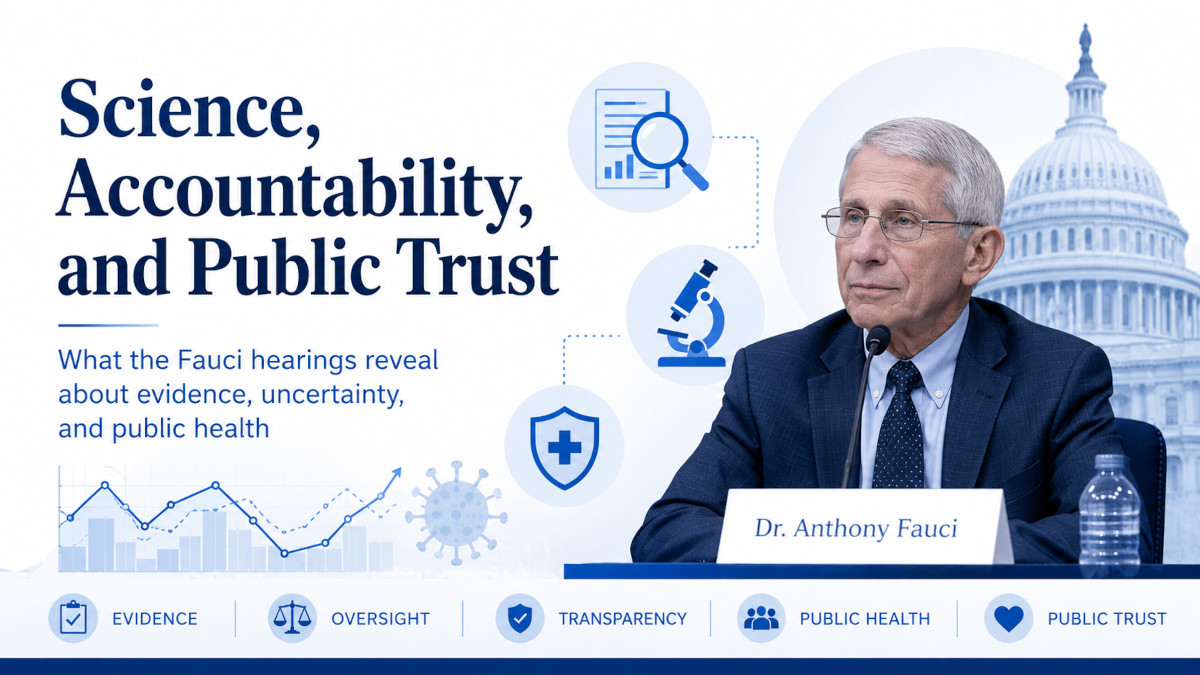
The recent congressional proceedings involving Dr. Anthony Fauci raise questions that go beyond disagreements about his role during the COVID-19 pandemic. The larger issue is how scientists and public-health officials should be held accountable when evidence evolves, uncertainty is unavoidable, and scientific review becomes intertwined with political and legal conflict. Meaningful accountability should examine what officials knew at the time, how decisions were made, how uncertainty was communicated, and what should be done differently in the future.
Key Points
- Scientific conclusions can change as evidence develops. A change in guidance or position does not automatically mean earlier statements were dishonest.
- Public-health communication during COVID-19 was not always handled well. Presenting uncertain evidence with too much confidence can damage trust when recommendations later change.
- Accountability remains necessary. Officials should explain their decisions, reasoning, mistakes, and what they would do differently.
- Legal and political pressure can change the nature of scientific inquiry. When participants fear prosecution, they have strong incentives to say less rather than openly discuss uncertainty and judgment.
- The broader concern is future public health. If scientists come to view public service as carrying excessive political, legal, or personal risk, government institutions may struggle to attract the expertise they need during the next crisis.
Why This Question Matters
Anthony Fauci remains one of the most polarizing figures associated with the COVID-19 pandemic.
For some people, he represents scientific expertise and decades of public service. For others, he represents decisions and public-health policies they strongly oppose.
That disagreement is unlikely to disappear anytime soon.
But the recent congressional proceedings involving Fauci raise a broader question that deserves more attention than whether someone personally likes or dislikes him:
How should we hold scientists and public-health officials accountable when they make decisions during a rapidly evolving crisis?
That question matters well beyond Anthony Fauci. It affects how we prepare for the next pandemic, how scientists communicate uncertainty, and whether highly qualified researchers will continue to view public service as worth the personal and professional risks that can come with it.
Accountability Still Matters
Scientists and public-health officials shouldn't be exempt from scrutiny.
Important questions remain about the COVID-19 pandemic, including the origin of SARS-CoV-2, research funding, laboratory safety, public-health communication, masking recommendations, school closures, vaccination policies, and how officials communicated what they knew and did not know.
Some decisions made during the pandemic deserve careful reassessment.
Medical ethicist Arthur Caplan made an important distinction when discussing Fauci's recent testimony. He argued that Fauci still has an ethical responsibility to explain what happened, what decisions he made, and what he would do differently.
At the same time, Caplan questioned whether a congressional proceeding conducted under the threat of potential criminal prosecution is the right setting for obtaining those answers.
That distinction matters.
Accountability should help us understand what happened and improve future decisions. It shouldn't simply identify someone to blame.
Science Changes When the Evidence Changes
One of the most difficult aspects of communicating science during the pandemic was that the evidence kept changing.
That's not unusual.
Science works by developing explanations from available evidence, testing them, and revising conclusions when better information becomes available.
Monica Bertagnolli, president of the National Academy of Medicine, describes this as a fundamental part of scientific problem-solving. Scientists form hypotheses, evaluate them against available data, and revise their conclusions when the evidence requires it.
That process becomes much more complicated during a public-health emergency.
At the beginning of the COVID-19 pandemic, scientists were trying to understand a new virus while infections were spreading rapidly around the world. Information about transmission, severity, treatment, immunity, and prevention developed over time.
A recommendation changing several months later therefore does not, by itself, demonstrate that someone lied earlier.
Historian Joanne Freeman makes this point in discussing Fauci. Officials were learning throughout the pandemic, just as researchers and the public were. Treating every change in position as evidence of dishonesty ignores how scientific knowledge develops during an unfolding crisis.
That does not mean every change was handled well.
It means we need to ask a better question:
Given the evidence available at the time, was the decision reasonable, and was the uncertainty communicated appropriately?
That's a much more useful standard than evaluating an early-pandemic decision solely using information that became available months or years later.
Public Health Also Made Communication Mistakes
Acknowledging scientific uncertainty should not become an excuse for poor communication.
Caplan argues that public-health officials sometimes presented conclusions with greater certainty than the evidence justified.
He suggests that officials may have worried that openly discussing uncertainty would reduce public compliance with recommendations such as vaccination, masking, or social distancing.
The problem is that excessive certainty creates another risk.
When recommendations later change, people may conclude that experts were incompetent or dishonest rather than recognizing that the evidence changed.
Caplan's broader point is important: science responds to evolving evidence. Communicating scientific conclusions as though they are permanent certainties can ultimately damage trust.
That lesson extends far beyond COVID-19.
We see the same challenge in diabetes research, nutrition, cardiovascular medicine, obesity treatment, and medication safety.
Evidence evolves.
Guidelines change.
Treatments that once appeared promising sometimes disappoint in larger trials. New evidence can reveal risks that were not apparent earlier.
Good scientific communication should make room for that uncertainty rather than pretending it doesn't exist.
What Happens When Scientific Review Becomes a Legal Battle?
Fauci's decision to invoke his Fifth Amendment rights during recent congressional questioning has generated considerable criticism.
Some people interpret refusing to answer questions as evidence that he has something to hide.
But there's another issue worth considering.
Bertagnolli argues that once scientific disagreement becomes intertwined with potential criminal prosecution, the incentives change. A scientist who believes that testimony might be used to build a criminal case is no longer participating only in a discussion about evidence or public-health policy.
The proceeding becomes a legal matter as well.
Heather Cox Richardson similarly emphasizes that Fauci had previously testified before Congress extensively, while describing the current environment as different because the possibility of prosecution has become part of the dispute.
Whether someone agrees with Fauci's decision to invoke the Fifth Amendment or not, the situation raises an important institutional question.
If the goal is to understand what happened during the pandemic, what kind of process is most likely to produce useful answers?
A process designed around evidence, expert testimony, documentation, competing interpretations, and careful examination of uncertainty might teach us quite a lot.
A process in which participants believe that an incorrect phrase, inconsistency, or incomplete recollection could expose them to prosecution creates very different incentives.
People become less likely to explain uncertainty openly and more likely to say as little as possible.
That's not particularly useful for scientific learning.
The Risk Goes Beyond Fauci
Bertagnolli raises another concern that deserves serious consideration.
What message do highly publicized investigations send to scientists considering careers in public service?
Fauci spent decades in government and became one of the most recognizable scientists in the world during COVID-19. Whatever someone thinks of his pandemic decisions, his experience demonstrates the extraordinary political, personal, and even physical risks that can accompany a highly visible scientific role.
Bertagnolli argues that younger scientists may reasonably look at cases like this and choose careers where those risks are lower.
That could have consequences for public health.
Government agencies need people who are willing to provide scientific advice when the evidence is incomplete, the stakes are high, and the conclusions may be politically unpopular.
If scientists learn that the safest career strategy is to avoid public service, avoid controversial questions, or avoid stating conclusions that powerful people dislike, public institutions may eventually lose exactly the expertise they need most.
We Also Need to Be Careful About How We Remember COVID-19
Freeman raises another issue that's easy to overlook: the way societies reconstruct complicated events after they are over.
The COVID-19 pandemic was chaotic.
Different states adopted different policies. Scientific understanding changed. Governments made mistakes. Individuals made mistakes. Hospitals faced enormous pressure. Researchers learned in real time. Political leaders disagreed. Public-health agencies changed recommendations.
Years later, there is a temptation to compress all of that complexity into a much simpler story.
Someone becomes the hero.
Someone becomes the villain.
Every good outcome becomes evidence supporting one side, while every bad outcome becomes evidence against the other.
Freeman warns about attempts to reshape the historical memory of the pandemic around simplified political narratives.
Regardless of someone's political perspective, that's a useful warning.
If our goal is to prepare for the next public-health emergency, we need an accurate understanding of what happened during the last one.
That means acknowledging successful decisions and failed ones.
It means recognizing where evidence was strong and where it was weak.
It means distinguishing uncertainty from deception.
And it means resisting the temptation to make one person responsible for an event involving governments, healthcare systems, researchers, businesses, communities, and billions of individual decisions around the world.
Accountability Should Follow the Evidence
None of this requires believing that Anthony Fauci made every decision correctly.
He almost certainly did not.
Neither did other public-health officials, political leaders, researchers, healthcare systems, or governments responding to a crisis unlike anything they had experienced in generations.
Those decisions should be examined.
Officials should explain their reasoning.
Communication failures should be identified.
Research decisions should be scrutinized.
Policies should be evaluated against the evidence available at the time and against what we learned afterward.
That's how accountability can improve science and public health.
But accountability works best when the objective is understanding rather than punishment, and when conclusions emerge from evidence rather than preceding it.
The most important lesson from the current controversy may therefore have little to do with whether someone personally supports or opposes Anthony Fauci.
It may be about the kind of scientific culture we want when the next crisis arrives.
We need scientists who are willing to say what the evidence shows.
We also need institutions willing to question them rigorously when necessary.
Those principles are not in conflict.
Scientists should not be beyond criticism.
But if criticism is going to serve science and public health, it should follow the evidence too.
Sources
Confessions from the Pandemic? Dr. Fauci & US Senators — Brent Goff Reports
Why we all need to care about what happens to Dr. Tony Fauci — Monica Bertagnolli, President, National Academy of Medicine
A Few Thoughts For Those Who Can't Sleep -- August 6 Edition — Dr. Joanne Freeman
Dr. Anthony Fauci Invokes the Fifth Amendment | Explainer — Heather Cox Richardson