
Summary
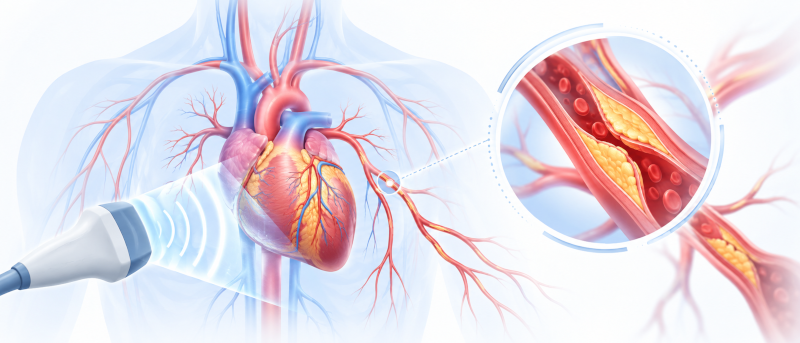
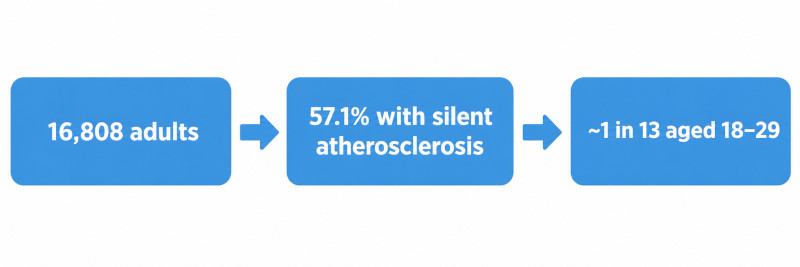
The REACT study suggests that silent atherosclerosis begins much earlier and is far more common than many people may realize. Among 16,808 adults without known atherosclerotic cardiovascular disease, 57.1% had detectable atherosclerosis, including about 1 in 13 adults aged 18 to 29. Rather than relying only on estimates of future cardiovascular risk, REACT is exploring whether directly detecting disease could support more personalized prevention. Phase 1 shows that early disease can be identified, but Phase 2 will need to determine whether finding and treating it earlier actually reduces cardiovascular events.
Key Points
- Silent atherosclerosis was common: Researchers detected it in 57.1% of 16,808 adults aged 18 to 70 without known atherosclerotic cardiovascular disease.
- Disease can begin surprisingly early: About 1 in 13 adults aged 18 to 29 already had detectable atherosclerosis.
- REACT challenges a risk-only approach: Current tools estimate the likelihood of future cardiovascular disease, while REACT examines whether atherosclerosis is already present.
- Peripheral ultrasound could eventually offer a practical way to detect early disease, since coronary atherosclerosis often occurred alongside carotid or femoral disease. However, routine screening has not yet been shown to improve outcomes.
- Phase 2 is the critical next step: It will test whether imaging-guided, personalized prevention can slow atherosclerosis and reduce heart attacks, strokes, and other cardiovascular events compared with current practice.
Rethinking Cardiovascular Disease Prevention
Cardiovascular prevention has traditionally focused on estimating risk.
Age, sex, blood pressure, cholesterol levels, smoking status and other factors help determine how likely someone is to experience a heart attack, stroke or other cardiovascular event in the future.
The REACT initiative is exploring a different approach: What if clinicians could identify atherosclerosis itself, years or even decades before symptoms appear?
Results from the first phase of REACT, presented at ESC Congress 2026 and published in The New England Journal of Medicine, suggest that silent atherosclerosis begins earlier and is substantially more common than many people may realize.
Among 16,808 adults aged 18 to 70 without known atherosclerotic cardiovascular disease, researchers detected silent atherosclerosis in 57.1%. Approximately 1 in 13 participants aged 18 to 29 already had detectable disease. By ages 60 to 70, prevalence had increased to about 9 in 10.
The findings raise an important question for cardiovascular prevention: Could detecting disease directly improve on strategies that primarily estimate future risk?
Looking for Disease Rather Than Estimating Risk
REACT enrolled adults from Denmark and Spain and used several imaging methods to examine the arteries directly.
Three-dimensional vascular ultrasound assessed the carotid arteries in the neck and femoral arteries in the legs. Coronary CT angiography and CT calcium assessment were used to examine the coronary arteries supplying the heart.
This distinction is central to the study.
Current cardiovascular prevention commonly relies on risk models that estimate the probability of future cardiovascular disease using characteristics such as age, sex, smoking, blood pressure and cholesterol.
Those models remain valuable, but they estimate risk rather than establish whether atherosclerosis is already present.
REACT researchers examined how well conventional risk assessment identified people who actually had silent atherosclerosis. The SCORE2 risk tool classified only a small minority of participants with detectable disease as high risk, with the gap particularly apparent among younger adults.
That doesn't mean existing cardiovascular risk tools should be abandoned. Instead, REACT raises the possibility that future prevention could combine conventional risk assessment with direct evidence of disease.
Current Approach
Estimate cardiovascular risk
REACT Concept
Detect atherosclerosis → personalize prevention → test whether outcomes improve
Atherosclerosis Can Begin Surprisingly Early
One of the most notable findings was how early atherosclerosis appeared.
Among adults aged 18 to 29, the NEJM study found atherosclerosis in 8.7% of men and 6.7% of women. Across subsequent age groups, both the amount of plaque and the number of affected arterial territories increased.
The study also found different patterns between women and men.
Atherosclerosis prevalence increased earlier in men, whose disease trajectory was approximately five to ten years ahead of women. Women showed a later but particularly steep increase during midlife, broadly around the menopausal transition.
These findings reinforce an important characteristic of atherosclerosis: it can develop silently for many years before producing symptoms such as angina or before contributing to a heart attack or stroke.
The period before symptoms appear may therefore represent an important opportunity for prevention.
Why Peripheral Artery Imaging Could Matter
REACT also produced an observation with potential implications for how early disease might eventually be detected.
Most participants with atherosclerosis in the coronary arteries also had disease in the carotid or femoral arteries.
That matters because the carotid and femoral arteries can be examined with ultrasound, which is generally simpler and less invasive than coronary CT angiography.
The researchers envision a future in which portable vascular ultrasound could potentially help identify early atherosclerosis in clinical settings.
That possibility is intriguing, but it is also important to distinguish it from established clinical practice.
REACT has not yet shown that routine vascular ultrasound screening of asymptomatic adults improves cardiovascular outcomes.
Detecting more disease does not automatically mean that screening improves health. A useful screening strategy must ultimately demonstrate that identifying disease earlier and acting on those findings leads to better outcomes than current approaches.
That is one of the major questions REACT still needs to answer.
More Than an Imaging Study
REACT is also notable for the amount and variety of data being collected.
The broader initiative combines vascular imaging with clinical measurements, questionnaires, blood and urine analyses, lifestyle information, genetics and other forms of multi-omics data.
One of its objectives is to develop age- and sex-specific models for predicting silent atherosclerosis. The study design describes a two-tiered machine-learning approach: one based on widely available clinical information and another incorporating high-dimensional omics data to refine risk assessment in selected groups.
Researchers are also examining potential relationships between atherosclerosis and factors beyond the traditional cardiovascular risk markers.
This makes REACT more than a study of whether ultrasound or CT can find plaque.
It is an effort to build a detailed picture of who develops atherosclerosis, when it begins, where it occurs and what biological, clinical and lifestyle factors may help predict its development.
The ultimate goal is a more individualized approach to cardiovascular prevention.
Phase 2 Will Test the More Important Question
The first phase of REACT primarily answers a descriptive question: how common is silent atherosclerosis across adult life?
The next phase is intended to address the question that matters most clinically.
Investigators plan a large randomized trial examining whether an imaging-guided precision prevention strategy can slow or reduce the progression of atherosclerosis and ultimately reduce cardiovascular events compared with current practice.
That distinction is critical.
Phase 1 shows that clinicians can detect substantial amounts of atherosclerosis in people without known cardiovascular disease.
It does not yet demonstrate that finding and treating that disease earlier prevents heart attacks, strokes or cardiovascular deaths.
If Phase 2 shows that imaging-guided prevention improves outcomes, REACT could provide evidence for a meaningful change in how cardiovascular prevention is approached.
If it doesn't, Phase 1 will still have provided important information about how atherosclerosis develops across adult life.
Why This Matters for Cardiometabolic Care
The REACT findings are especially relevant to the broader cardiometabolic discussion.
Cardiovascular disease, type 2 diabetes, obesity, hypertension and abnormal lipid levels frequently intersect, and cardiovascular risk reduction has become an increasingly important part of diabetes and obesity management.
REACT itself, however, should not be interpreted as a study establishing a new screening strategy specifically for people with diabetes or obesity. The current results describe silent atherosclerosis across a broad population of adults without known atherosclerotic cardiovascular disease.
Its larger significance lies in the prevention model being tested.
Cardiovascular medicine has become increasingly sophisticated at predicting who is likely to develop disease. REACT asks whether prevention could become even more precise by adding another piece of information:
Is the disease already there?
Mads Krogsgaard Thomsen, CEO of the Novo Nordisk Foundation, which funds REACT, summarized the underlying idea by noting that effective prevention requires understanding what happens before disease becomes clinically apparent. He also pointed to the next question: whether earlier, more precise and personalized prevention can reduce future heart attacks, strokes and other cardiovascular events.
REACT Phase 1 provides strong evidence that atherosclerosis often begins well before cardiovascular disease becomes clinically visible.
Phase 2 will help determine whether finding it sooner allows medicine to change what happens next.
That may ultimately be the most important finding of all.
References
Prevalence of Silent Atherosclerosis across Adult Life. New England Journal of Medicine.
Hasselbalch, Rasmus Bo, et al. Prevalence and predictors of silent atherosclerosis across life: Design of the REACT Phase 1 study. American Journal of Preventive Cardiology.
Novo Nordisk Foundation. One in three people die due to atherosclerosis: A new initiative aims to find new ways to prevent it.
European Society of Cardiology. Early imaging of atherosclerosis identifies silent disease not captured by conventional risk assessment.
Fierce Pharma. Novo Nordisk’s Wegovy helps free 40% of kids from obesity in phase 3 trial.
Medical Device Network. ESC 2026: Identifying ‘silent’ atherosclerosis may help reduce global CVD burden.
REACT. Rethinking Heart Disease Prevention. Vimeo.
Mads Krogsgaard Thomsen. We need to understand what happens before it begins. LinkedIn.