
Eli Lilly’s investigational triple agonist retatrutide produced substantial weight loss in two additional Phase 3 trials involving people with obesity and serious related health conditions.
In TRIUMPH-2, participants with obesity or overweight and type 2 diabetes lost an average of up to 20.8% of their body weight after 80 weeks, along with A1C reductions of up to 1.6 percentage points. In TRIUMPH-3, participants with severe obesity and established cardiovascular disease lost up to 22.6%.
The results are impressive, particularly because people with type 2 diabetes often lose less weight in obesity medication trials. But the largest average weight-loss percentage does not necessarily identify the best treatment for an individual patient.
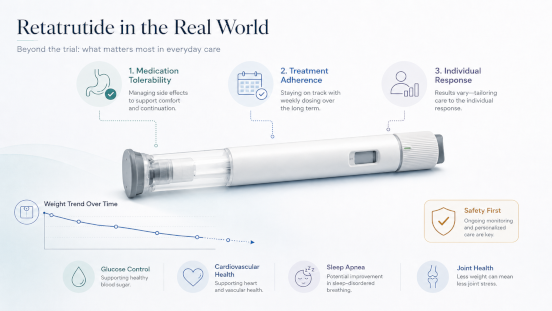
In clinical practice, three questions may matter more:
- Can the patient tolerate the medication?
- Will the patient remain on treatment and take it as directed?
- Does the medication produce meaningful benefits for that patient?
Gastrointestinal adverse effects remained common, and 13.5% of participants receiving the highest dose in TRIUMPH-3 discontinued treatment because of adverse events. This suggests that retatrutide’s real-world effectiveness could differ considerably from its efficacy under clinical trial conditions.
Retatrutide may eventually prove particularly valuable for people with obesity and multiple related conditions. Its clinical development program extends beyond weight loss to type 2 diabetes, cardiovascular and renal outcomes, obstructive sleep apnea, knee osteoarthritis, and metabolic liver disease.
Its broader potential does not yet establish retatrutide as the preferred treatment for patients with multiple comorbidities. Semaglutide and tirzepatide already have approved uses and established evidence across several conditions, while retatrutide remains investigational. The latest study also did not establish that retatrutide reduces heart attacks, strokes, or cardiovascular deaths.
Retatrutide may raise the efficacy benchmark, but its eventual role will depend on tolerability, long-term adherence, clinical outcomes, access, and whether its broader benefits are confirmed in individual patient populations.
Lilly plans to submit retatrutide to the FDA in the first quarter of 2027.
Sources
Eli Lilly and Company: "Lilly's triple agonist, retatrutide, successful in two additional Phase 3 obesity trials, delivering significant improvements in weight and A1C"
Fierce Biotech: "Lilly’s triple-G drug hits 22.6% weight loss, but impact on reducing cardio risk is less clear"
BioPharma Dive: "Lilly, with new data, to seek FDA approval of obesity drug retatrutide"