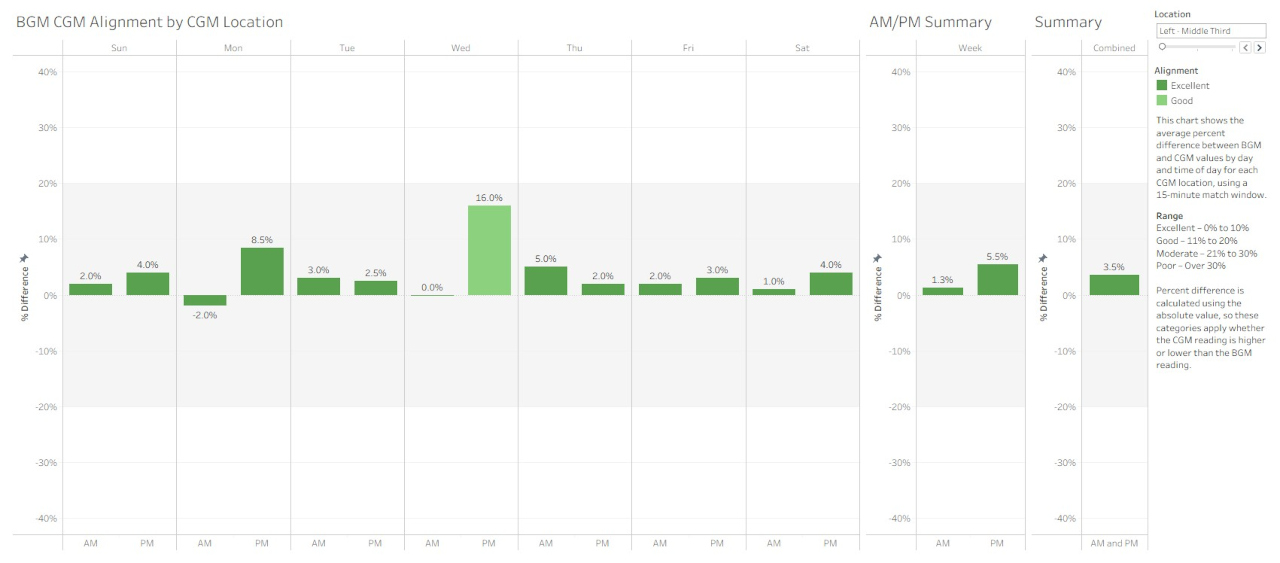
A look at how closely my CGM readings reflect actual blood glucose—and what that reveals about sensor placement and performance.
Abstract
Explore how well continuous glucose monitor (CGM) readings align with blood glucose meter (BGM) results, using real-world data and a 15-minute pairing window. By tracking percent differences and visualizing trends, it becomes easier to evaluate sensor placement, detect performance issues, and make more confident decisions.
Key Points
CGM and BGM measure glucose in different body compartments, with CGM readings naturally lagging 5–15 minutes behind blood glucose levels.
Even properly functioning sensors can show differences—up to 20% variance is considered acceptable under FDA and clinical standards.
Pairing BGM and CGM readings within a 15-minute window helps identify when differences are expected and when they may indicate sensor issues.
Sensor placement significantly affects accuracy, with some sites showing more consistent alignment than others.
Tracking alignment over time supports better decision-making, helping to distinguish between natural fluctuations and device-related discrepancies.