
- Details
- By J. Smith
- Hits: 337
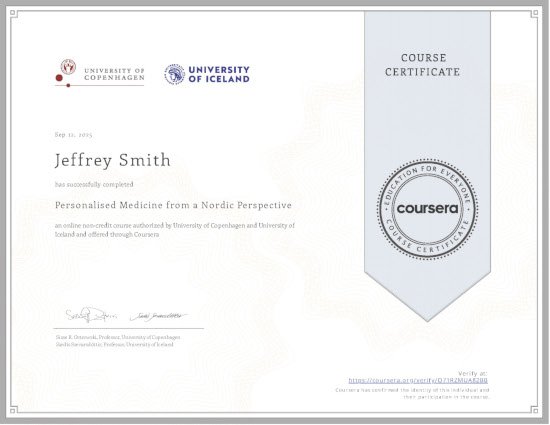
I completed Personalised Medicine from a Nordic Perspective through the University of Copenhagen and University of Iceland. The course explored how biobanks (collections of biological samples), health registries, and biomarkers (measurable health indicators) can be used to guide individual care, while also addressing risk communication, data protection, and broader ethical considerations.
People with diabetes often generate large amounts of data through continuous glucose monitors (CGMs), blood glucose meters (BGMs), and other wearables. This course highlights how similar kinds of data are used in healthcare systems to guide individual care, protect privacy, and support better outcomes. The material is presented in a way that makes these complex topics accessible to a broader audience, not just specialists.
This course was built and launched by two principal collaborators, Sisse Rye Ostrowski, MD, University of Copenhagen and Sædís Sævarsdóttir, MD, University of Iceland. They summed up its importance this way:
“The healthcare system is a wonderful place to be if you’re interested in data and developing algorithms. There are extremely complex data like omics data, register data, and data from wearables with all kinds of measurements you could possibly imagine. So, the healthcare field is the data playground of the future.” - Ostrowski
“We want people to understand the challenges involved and how collaboration and technological innovation is the key to shaping the future of healthcare.” - Sævarsdóttir
Explore the Course: Personalised Medicine from a Nordic Perspective
- Details
- By J. Smith
- Hits: 379
Researchers have found blood-based epigenetic markers that may help predict heart disease risk in type 2 diabetes, offering a potential path to more personalized prevention and care.
Abstract
An international research team led by Lund University Diabetes Centre has discovered blood-based epigenetic markers that may help predict which people with type 2 diabetes are at risk of serious cardiovascular events. In a study of 752 newly diagnosed participants followed for just over seven years, a scoring tool based on DNA methylation patterns outperformed standard clinical risk calculators, particularly in ruling out low-risk individuals. While further validation is needed, this approach could lead to a simple blood test that supports more personalized prevention and treatment strategies in type 2 diabetes care.
Key Points
- Study Scope: Followed 752 newly diagnosed type 2 diabetes patients for an average of 4 years, identifying 102 major cardiovascular events.
- Main Finding: Developed a DNA methylation-based score using 87 sites that predicted heart risk more accurately than standard clinical risk scores.
- Low-Risk Identification: The tool had a 96% probability of correctly identifying those unlikely to develop cardiovascular disease.
- Limitations: Short follow-up period, limited diversity, moderate positive predictive value, and missing lifestyle data.
- Future Potential: Could evolve into a simple blood test to guide personalized prevention, treatment, and follow-up in type 2 diabetes.
Read more: Epigenetic Clues to Heart Risk in Type 2 Diabetes
- Details
- By J. Smith
- Hits: 402

Abstract
This post explains why I took medical courses to gain a deeper understanding of the clinical side of type 2 diabetes and obesity care. The insights gained help me better interpret the data, support public education, and present CGM and related metrics in a more informed way.
Key Points
- Medical coursework offered critical insight into diabetes and obesity care priorities.
- Understanding clinical perspectives shaped how I interpret CGM data.
- CME courses emphasized scientific integrity and commercial neutrality.
- These experiences support better health communication and patient education.
- Learning from clinicians strengthens how I present data to the public.
Read more: Why I Took Medical Courses to Strengthen My Data Skills
- Details
- By J. Smith
- Hits: 632
Abstract
A new study led by researchers at the University of Copenhagen and Karolinska Institutet reveals that insulin resistance varies widely between individuals, even among those with the same diagnosis. By analyzing muscle tissue from over 120 people, the team uncovered unique molecular "fingerprints" that could help detect insulin resistance earlier and guide more personalized treatments for type 2 diabetes. Professor Juleen Zierath, a pioneer in exercise and metabolic research and winner of the 2024 Diabetes Prize for Excellence, played a key role in the study. The findings highlight the importance of moving beyond one-size-fits-all approaches in diabetes care.
Key Points
- Researchers discovered unique molecular “fingerprints” in muscle that reveal how individuals respond to insulin.
- Insulin resistance varies widely, even among people with the same diagnosis.
- Some individuals with type 2 diabetes respond better to insulin than those without the condition.
- A human-specific muscle protein, AMPKγ3, may offer a new target for treatment.
- The findings support more personalized and earlier approaches to diabetes care.
Read more: New Research Reveals the Hidden Complexity of Insulin Resistance
- Details
- By J. Smith
- Hits: 393
In a groundbreaking move that promises to revolutionize healthcare research, Denmark has announced a collaboration with the Novo Nordisk Foundation and NVIDIA to establish a national center for AI innovation. This center will be home to one of the world's most powerful AI supercomputers, named Gefion, after the Norse goddess of foresight and abundance. The initiative is a beacon of hope for advancements in the care and treatment of type 2 diabetes and obesity, among other societal challenges.
Accelerating Healthcare Innovation
The Danish Centre for AI Innovation is not just a technological marvel; it's a commitment to harnessing the power of artificial intelligence to foster scientific discoveries and healthcare solutions. With Denmark's rich digital healthcare data set and existing strengths in life sciences research, the center is well-positioned to make significant strides in drug discovery and precision medicine.
Mads Krogsgaard Thomsen, CEO of the Novo Nordisk Foundation, emphasizes the transformative potential of this initiative, aligning perfectly with strategic priorities in AI and healthcare. The center will enable Denmark's researchers and innovators to accelerate research in critical areas such as human and planetary health.
The Gefion Supercomputer: A Game-Changer for Research
At the heart of the Danish Centre for AI Innovation lies the Gefion supercomputer. Powered by NVIDIA H100 Tensor Core GPUs and interconnected using NVIDIA Quantum-2 InfiniBand networking, Gefion is expected to be a top 25 supercomputer globally. This AI powerhouse will enable researchers to tackle computation-intensive tasks with unprecedented speed and efficiency.
The Gefion supercomputer will be instrumental in advancing research in protein structure prediction, drug design, and hybrid quantum-classical computing. It will also support the acceleration of the green transition and the development of fault-tolerant quantum computing.
A Focus on Type 2 Diabetes and Obesity
For the public, especially those affected by type 2 diabetes and obesity, the establishment of the Danish Centre for AI Innovation is particularly promising. These conditions are complex and multifaceted, requiring innovative approaches to treatment and care. The center's focus on AI-driven research and drug discovery could lead to breakthroughs in understanding these diseases, identifying new therapeutic targets, and developing more effective and personalized treatments.
The use of AI in healthcare has the potential to transform the way we approach chronic conditions such as type 2 diabetes and obesity. By analyzing vast amounts of data, AI can uncover patterns and insights that would be impossible for humans to detect on their own. This could lead to earlier detection, better risk assessment, and more tailored interventions that improve patient outcomes and reduce the burden on healthcare systems.
Ensuring Data Sovereignty and Security
The Danish Centre for AI Innovation is not only a hub for technological advancement but also a model for data sovereignty and security. The center will operate with the highest level of security, ensuring that sensitive data, such as patient health records, is handled with the utmost care. Researchers will always have full control of their data, with no permanent storage of data within the center.
The Road Ahead
The Danish Centre for AI Innovation is set to be ready for pilot projects before the end of 2024, with full operational capacity expected in early 2025. This timeline places Denmark on the fast track to becoming a global leader in AI-driven healthcare solutions.
As the center becomes operational, we can anticipate a surge in AI-based research and business development that will not only impact the Danish economy but also contribute to global efforts to improve health outcomes. The public, particularly those living with type 2 diabetes and obesity, can look forward to a future where AI and human ingenuity converge to create a healthier society.
The Danish Centre for AI Innovation represents a significant step forward in the application of AI to healthcare challenges. With the power of the Gefion supercomputer and the collaborative efforts of researchers and innovators, Denmark is poised to make meaningful progress in the fight against type 2 diabetes, obesity, and other pressing health issues. This project exemplifies the potential of AI to augment our efforts in creating solutions that benefit everyone.
Frequently Asked Questions
What specific measures are being taken to protect the privacy and security of healthcare data used in AI research at the center?
To protect healthcare data privacy and security, the center will operate with the highest level of security, ensuring data sovereignty and allowing researchers full control of their data at all times, without permanent storage within the center.
How will the center's research impact the everyday treatment and management of diseases like type 2 diabetes and obesity?
the center's focus on AI-driven research in healthcare promises advancements in drug discovery and precision medicine that could lead to more effective treatments for diseases like type 2 diabetes and obesity.
What are the long-term goals of the Danish Centre for AI Innovation, and how does it envision its role in the global AI research community?
Long-term goals for the Danish Centre for AI Innovation include becoming a leading hub for AI-based research and business development, impacting the Danish economy and society broadly, and contributing to global efforts in healthcare and other fields.
Page 1 of 2