Hourly glucose visualizations replace judgment with understanding by showing when patterns occur and reducing the emotional burden of daily performance scores.
Abstract
Continuous glucose monitoring provides valuable information, but traditional daily Time in Range summaries often create unnecessary emotional pressure. This article explores how hourly Time in Range and Coefficient of Variation visualizations offer a more supportive, more insightful way to understand glucose patterns. By focusing on timing, consistency, and possibility, these visualizations shift the experience from judgment to clarity and help people interpret their data with confidence.
Key Points
- Daily percentages flatten important details and can feel like performance scores rather than meaningful descriptions of glucose patterns.
- Hourly visualizations reveal timing, making it easier to understand post-meal spikes, overnight stability, and recurring trends.
- Neutral design choices, including a green–blue color scale and multi-day aggregation, reduce judgment and lower emotional burden.
- Perspectives from the diabetes community highlight the need for data tools that support understanding instead of creating guilt or anxiety.
- Side-by-side views of time in range and variability help people and clinicians interpret patterns more effectively and focus on what is possible.
The Emotional Weight Behind the Numbers
Continuous glucose monitoring gives people an incredible amount of information. It offers clarity, early warnings, and insight that older tools simply couldn’t provide. Yet the way this information is presented can also create emotional pressure. A single Time in Range (TIR) percentage can feel like a daily performance review, even though it reflects the natural ups and downs of everyday life. That pressure is well-documented in clinical resources that note how daily summaries often feel like a grade instead of a description of patterns.
Stacey Simms captured this feeling clearly when she responded to a discussion about Time-in-Tight-Range on LinkedIn. She said it “seems like another ‘you’re doing it wrong’ metric” that creates guilt for caregivers and people with diabetes. That moment is what led me to ask a different question entirely: if the data itself is valuable, why does the presentation of it sometimes feel stressful?
Hourly glucose visualizations address that problem and provide a more complete, more supportive picture of glucose patterns.
Why Daily Percentages Fall Short
Daily TIR is familiar and useful. It tells us the percentage of time glucose readings fall within a chosen range. But it also hides what matters most: timing. A single percentage cannot show whether patterns occur after meals, during sleep, or during two very specific hours that have little impact on the rest of the day.
Daily summaries flatten the richness of CGM data and contribute to emotional pressure by feeling like a performance score.
For people trying to manage their glucose day after day, that flattening can change how the number feels. Two days with identical TIR percentages may have completely different patterns underneath. Without context, the percentage becomes a judgment rather than an insight.
A Shift in Thinking: Treat to What’s Possible
The turning point came from something Natalie Bellini said on the Diabetes Dialogue podcast. Paraphrasing her:
With diabetes, we don’t treat to what’s normal. We treat to what’s possible.
That framing changed the way I looked at glucose data.
Instead of comparing glucose patterns to an idealized standard, this perspective focuses on personal progress and realistic goals. It moves the emphasis away from perfection and toward possibility. Once that shift occurred, the path forward became clear: the data needed to be shown in a way that made patterns visible without judgment. It needed to help people understand when things were happening, why they were happening, and how consistent those patterns were.
That led directly to the creation of the hourly Time in Range (TIR) and Coefficient of Variation (CV) visualizations.
Designing Visualizations That Reduce Anxiety
These visualizations were built with one purpose: support understanding instead of judgment. The design choices reflect that goal from top to bottom.
1. Hourly Grouping to Reveal Timing
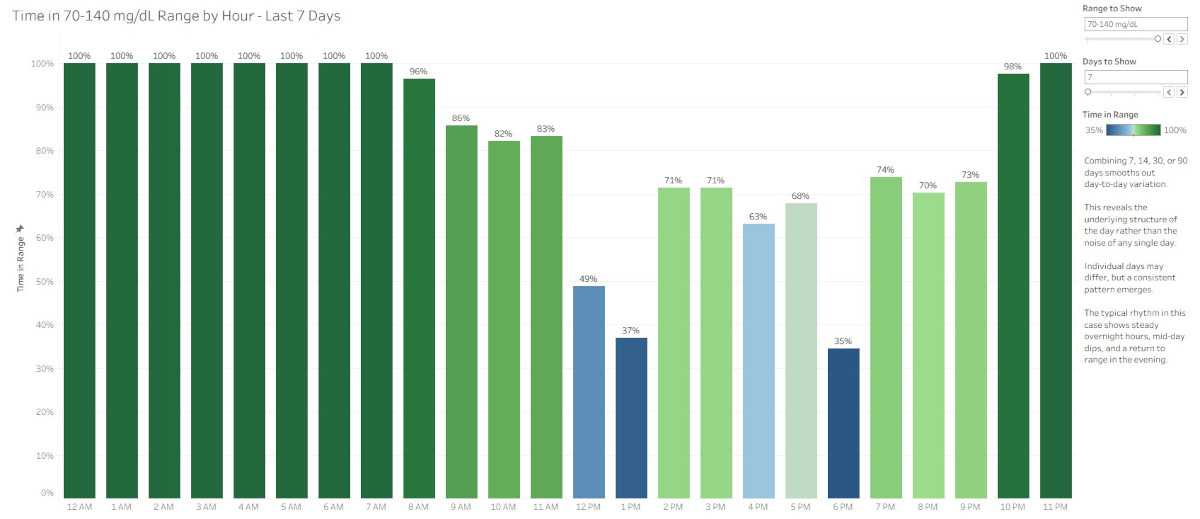
Grouping readings by hour provides clarity about *when* patterns occur.
Hourly bins highlight:
- Overnight stability
- Morning patterns
- Post-meal spikes
- Evening returns to range
This transforms the experience from looking at a grade to exploring a map.
2. Green–Blue Color Scale to Avoid Judgment
A neutral color scale supports interpretation without implying success or failure.
- Green simply means “more time in range” or “lower variation.”
- Blue means “less time in range” or “higher variation.”
- Neither color suggests that the person did something “wrong.”
3. Multi-Day Aggregation to Reduce Noise
Isolated highs or lows can be stressful when viewed in isolation. Multi-day aggregation smooths out noise and reveals stable patterns, improving confidence and reducing emotional pressure.
What remains visible are the patterns that matter, not the one-off events that can cause worry.
Voices from the Diabetes Community on LinkedIn
The emotional impact of CGM data is real, and the perspectives of people living with diabetes highlight why supportive visualization matters.
Stacey Simms expressed concern that time in tight-range metrics can feel like messages of failure rather than tools for learning.
Cherise Shockley commented that she wants to “LIVE with diabetes, not obsess over the data”. This reinforces the importance of keeping data informative without making it overwhelming.
Julie Keller Heverly, a patient advocate with more than 234,000 hours of lived experience, emphasized that personalized care must avoid creating an unmanageable burden. She wrote that people need tools that support them without overwhelming them, and that the goal is a healthy, high-quality life.
These perspectives reflect what many people with diabetes know instinctively: the way we visualize data can either help or hinder emotional well-being.
How Hourly TIR and CV Visualizations Change the Experience
When emotional weight is reduced, people can focus on insight instead of judgment. These visualizations bring that shift to life.
For people with diabetes
- Clearer patterns without the pressure of a score
- More confidence from seeing what is consistent
- Flexible views for different glucose targets
- Context that reduces feelings of guilt or failure
For clinicians, educators, and analysts
- Hourly structure enables more informed conversations
- Side-by-side views of control and stability
- Emotionally neutral presentation encourages productive dialogue
- Multi-day layers reveal true patterns, not isolated events
The Bottom Line: Understanding Over Judgment
CGM data is powerful, but power alone isn’t enough. People need to understand their patterns without feeling judged by them. They need tools that provide insight, not anxiety.
Hourly visualizations shift the conversation from “How good was today?” to “What patterns shape my day?” That shift makes the data more humane and more actionable. As Julie Keller Heverly reminds us, the real goal is a healthy, quality life—not chasing a perfect number.
This approach brings clarity, lowers emotional burden, and helps people focus on what’s possible.
Sources
Example Time in Range and Coefficient of Variation (CV) Visualizations at Tableau Public
Guide to Time in Range (TIR) and Coefficient of Variation (CV) Visualizations at Github
LinkedIn - Heverly
LinkedIn - Weintraub (with comments from Stacey Simms, Cherise Shockley, and Natalie Bellini)