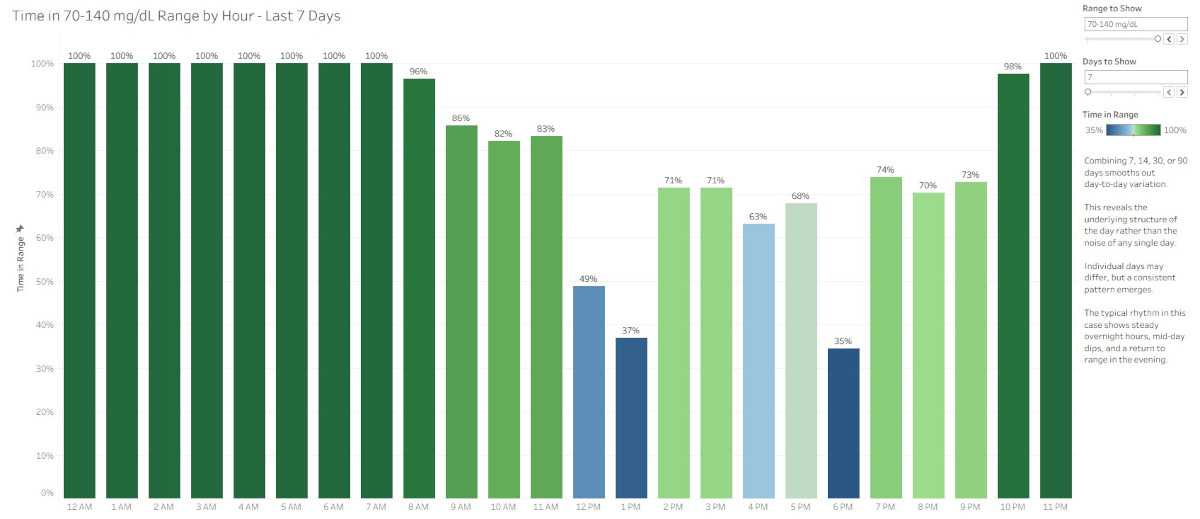
Hourly glucose visualizations shift the focus from judgment to understanding by showing when patterns occur and reducing the emotional burden of daily performance scores.
Summary
Continuous glucose monitor data is useful, but daily summary values don’t always show the full story. A single daily Time in Range percentage may show what happened overall, but it can’t show when glucose patterns occurred, whether they repeated, or how stable glucose levels were during specific parts of the day.
Time in Range by Hour and Variation by Hour offer a more detailed and emotionally neutral way to view CGM data. By shifting attention from daily scores to hourly patterns across multiple days, these visualizations help reveal timing, consistency, and recurring trends without turning the data into a judgment.
Key Points
- Daily Time in Range values are useful, but they don’t show when glucose patterns occur.
- A single daily percentage can feel like a score, even when it’s meant only as a summary.
- Hourly views add time-of-day context that daily summaries miss.
- Variation by Hour shows whether glucose levels are stable or more variable during those same periods.
- Multi-day hourly views help separate recurring patterns from isolated events.
- These visualizations are intended to support understanding, not replace standard CGM reports or clinical guidance.
The Big Picture
Continuous glucose monitors provide a detailed view of glucose levels throughout the day. They can show changes after meals, overnight patterns, exercise effects, medication timing, and other shifts that may be difficult to see with fingerstick readings alone.
That level of detail can be empowering. It can also feel heavy.
Many CGM reports summarize the day with a single Time in Range value. That number is familiar and useful, but it compresses an entire day into one percentage. It may show whether glucose stayed within range overall, but it doesn’t show when patterns occurred or whether the issue was spread across the day or limited to one difficult period.
That matters because glucose data can feel personal. A daily percentage may be intended as a neutral summary, but it can land like a grade. When the number looks lower than expected, it may feel as if the whole day went wrong, even when most of the day was stable.
Time in Range by Hour and Variation by Hour offer another way to look at the same CGM data. They don’t replace daily summaries. They add context by showing when patterns happen and how consistent those patterns are across multiple days.
The goal is simple: make glucose data easier to understand and easier to carry.
How This Fits with AGP
These hourly visualizations are not intended to replace the Ambulatory Glucose Profile (AGP), standard CGM reports, or conversations with healthcare professionals.
AGP remains valuable because it summarizes overall glucose patterns and provides a familiar clinical view. Time in Range by Hour and Variation by Hour work as companion views. They add time-of-day context that can make recurring patterns easier to see and discuss.
This distinction is important. The purpose of hourly visualizations is not to create another metric to chase. The purpose is to make existing CGM data clearer.
Problem: Daily Summary Values Don’t Tell the Full Story
Daily Time in Range shows the percentage of time glucose readings fall within a selected target range. It’s useful because it provides a quick summary of the day.
But quick summaries leave details behind.
A daily value can’t show whether glucose rose after breakfast, stayed steady overnight, varied after dinner, or returned to range quickly after a short increase. It also can’t show whether a pattern happened once or repeated across several days.
Two days can have the same Time in Range percentage and still look very different underneath.
One day may include mostly steady glucose levels with one short post-meal rise. Another may include smaller swings throughout the day. The daily number may look similar, but the meaning is not the same.
Daily variation values have a similar limitation. They can show whether glucose varied across the day, but they don’t show when glucose was stable and when it was not.
That missing context can add emotional weight. A single number can make a difficult period feel like a difficult day. A more detailed view can help separate the two.
Solution: Two Hourly Views That Show What Daily Summaries Miss
Time in Range by Hour and Variation by Hour provide a clearer way to explore CGM data.
Instead of showing only how the day looked overall, these visualizations show how glucose behaved during each hour of the day. When viewed across multiple days, they make recurring patterns easier to see.
Used together, they answer two related questions:
- How often was glucose in range during each hour?
- How stable was glucose during those same hours?
That combination creates a fuller picture than either view can provide on its own.
Time in Range by Hour
Time in Range by Hour shows the percentage of time glucose levels fall within a selected target range for each hour of the day.
This makes timing visible.
Instead of seeing only one daily percentage, the hourly view can show periods where glucose is most often in range and periods where glucose tends to rise or fall. It may highlight overnight stability, early morning changes, post-meal increases, or evening returns to range.
That context can change how the data feels.
A daily Time in Range value may look discouraging. But the hourly view may show that most hours were steady and that one repeated period, such as after lunch or dinner, accounted for much of the change. That is more useful than a single summary value because it points to where the pattern occurred.
It also feels less judgmental. The question becomes less about whether the day was good or bad and more about what happened at specific times.
Variation by Hour
Variation by Hour shows how much glucose readings fluctuate during each hour of the day. It uses Coefficient of Variation, or CV, to describe glucose stability.
This view matters because Time in Range alone doesn’t tell the whole story.
An hour may show a reasonable amount of time in range, but the readings during that hour may still swing more than expected. Another hour may show both high time in range and low variation, suggesting a steadier pattern.
Time in Range by Hour shows where glucose is landing.
Variation by Hour shows how consistently it stays there.
Together, these views can help identify periods that may deserve closer attention, such as post-meal hours with more variation, as well as periods that appear more stable, such as overnight or early morning hours.
In Practice: How Hourly Patterns Become Easier to See
Hourly views become most useful when they’re viewed across multiple days.
A single day can be noisy. Meals, activity, stress, illness, sleep, medication timing, sensor behavior, and ordinary daily variation can all affect glucose readings. Looking at one day alone may not show whether something is a pattern or a one-off event.
Multi-day hourly views help solve that problem.
Daily Views: The Summary
Daily views show one value for each day. They’re familiar and easy to understand, but they flatten detail. They can also feel like a performance score because the entire day gets reduced to one number.
Hourly Views by Day: The Context
Hourly views by day show what happened hour by hour during a single day. They add important context, but they still reflect that day’s specific circumstances.
Multi-Day Hourly Views: The Pattern
Multi-day hourly views aggregate hourly values across 7, 14, 30, or 90 days. This reduces the effect of isolated events and makes repeatable patterns easier to see.
That is where the view becomes especially useful.
Instead of reacting to one difficult reading or one difficult day, the focus shifts to what repeats. Patterns such as stable overnight readings, consistent post-meal rises, or recurring periods of variation become easier to identify.
This helps reduce emotional pressure because it separates recurring patterns from isolated events.
Why the Emotional Framing Matters
Glucose data can support better decisions, but it can also affect how people feel about themselves.
People with diabetes already manage a lot: medication, food choices, activity, sleep, stress, appointments, supplies, insurance, and the daily presence of numbers. When data appears as a score, it can add guilt or anxiety instead of clarity.
That concern appears often in diabetes community discussions, where people frequently describe the tension between wanting useful data and not wanting diabetes management to become constant self-monitoring. Some people experience new metrics as one more way to feel that they’re not doing enough. Others want useful data without feeling pulled into constant monitoring or perfectionism.
Those concerns should not be dismissed.
The answer is not to avoid data. It’s to present data in a way that supports understanding.
Hourly visualizations help by showing that one difficult period doesn’t define the whole day. They can also show what’s working, such as stable overnight patterns or repeated returns to range. That balance matters because people need to see strengths as well as challenges.
A more human view of glucose data doesn’t soften the facts. It shows the facts with better context.
Design Choices That Support Understanding
The design of these visualizations matters because design affects interpretation.
Hourly Grouping
Grouping readings by hour creates a consistent structure for comparison. Each hour becomes a way to examine timing, stability, and recurrence.
This structure helps show where patterns occur rather than only showing how the day averaged out.
Neutral Color Scale
The visualizations use a green-blue color scale rather than colors that imply success or failure.
Green indicates more time in range or lower variation. Blue indicates less time in range or higher variation.
The goal is not to label results as good or bad. The goal is to show differences clearly while keeping the emotional tone neutral.
Multi-Day Aggregation
Aggregating hourly data across multiple days reduces noise. It helps prevent one unusual meal, one stressful day, or one isolated sensor issue from dominating the interpretation.
This makes the view more practical and less reactive.
Key Benefits
For People with Diabetes
Time in Range by Hour and Variation by Hour can help people:
- See when glucose patterns occur
- Understand whether a difficult period reflects a recurring pattern or an isolated event
- Recognize stable parts of the day
- Put highs and lows into better context
- Have more focused conversations with healthcare professionals
- Spend less emotional energy interpreting one daily number
For Healthcare Professionals and Educators
These views can support more practical conversations by showing when patterns occur and how consistent they are.
Instead of discussing only the overall daily or multi-day Time in Range percentage, the conversation can focus on specific time periods. That may make it easier to talk about meals, medication timing, activity, sleep, stress, or other factors that affect glucose levels.
The views can also help separate broad concerns from focused opportunities. If most of the day looks stable and one period repeats as more variable, the discussion can become more specific and more useful.
The Bottom Line
Daily glucose summaries are useful, but they’re only part of the story.
A single daily Time in Range value can show what happened overall, but it can’t show when patterns occurred or whether those patterns repeated. It can also feel heavier than intended when the number looks discouraging.
Time in Range by Hour and Variation by Hour add the missing context. They show when glucose is in range, when it varies, and which patterns repeat across multiple days.
That changes the conversation.
Instead of asking whether a day was good or bad, these views help ask better questions:
- When did the pattern happen?
- Did it repeat?
- Was glucose stable during that time?
- What part of the day is already working well?
- Where might a small change make the biggest difference?
That’s a clearer and more human way to use CGM data.
A single number can never tell the whole story. Hour by hour, pattern replaces judgment, and understanding becomes easier to carry.
Sources
Time in Range and Variation by Hour presentation
Example Time in Range and Coefficient of Variation visualizations on Tableau Public
Guide to Time in Range and Coefficient of Variation visualizations on GitHub