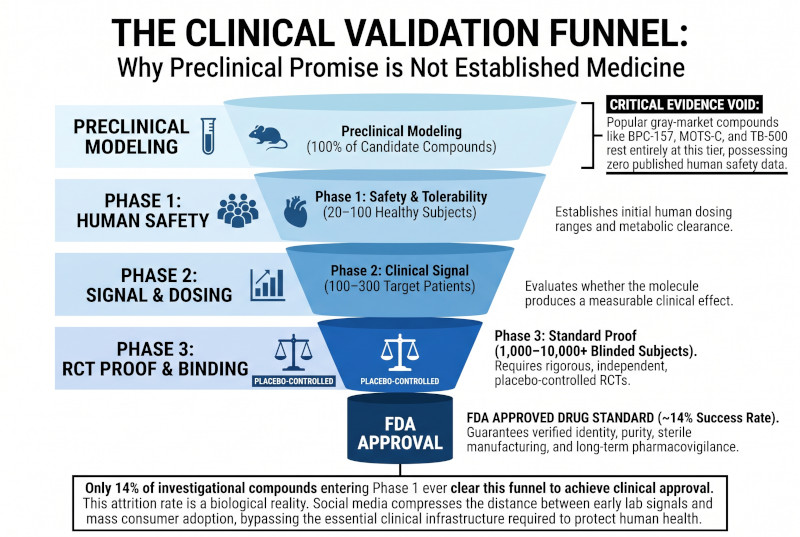
Large Clinical Validation Funnel Graphic (PDF): https://drive.google.com/file/d/1lKioUGkTtsc9Y_Z0KwtibNJUtcvrzC_K/view?usp=sharing
Summary
Peptides have become popular in wellness, fitness, longevity, and metabolic health discussions, but not all peptides belong in the same category. FDA-approved peptide medications, including insulin and GLP-1 receptor agonists, have been studied in human clinical trials, reviewed by regulators, prescribed by clinicians, and monitored after approval. Gray-market “research peptides” such as BPC-157 are different. They may be promoted online for healing, recovery, inflammation, or optimization, but they often lack strong human evidence, clear dosing, reliable safety data, product quality controls, and meaningful medical oversight. The key issue is not whether peptides are good or bad. The real issue is whether a specific peptide has enough human evidence, manufacturing quality, and clinical monitoring to support its use.
Key Points
- Approved peptide medications and gray-market peptides are not the same.
Insulin and GLP-1 medications have clinical trial data, regulatory review, professional prescribing, and post-approval monitoring. Gray-market peptides may not have the same evidence or safeguards. - Known risks are different from unknown risks.
Approved medications may have visible side effects because they have been studied and labeled. Unapproved products may appear safer simply because they have fewer studies, weaker monitoring, and less reporting. - BPC-157 claims go beyond the available human evidence.
BPC-157 is often promoted for recovery, healing, inflammation, and optimization, but the post notes that it has a very small published human evidence base, no completed randomized controlled trials, no FDA approval, and a canceled Phase 1 trial that was never published. - Injection raises the stakes.
Injectable peptides bypass the digestive system and may enter systemic circulation intact, creating important questions about dosing, absorption, half-life, receptor effects, off-target effects, and long-term safety. - This is partly a trust problem.
People may trust social media stories, wellness clinics, influencers, or “optimization” messaging more than approved medications because those messages feel personal and empowering. But moving trust from regulated medicine to social media wellness marketing can mean moving into a system with fewer safeguards and less transparency.
Not All Peptides Are the Same
Peptides are getting a lot of attention in wellness, fitness, longevity, and metabolic health circles. Some of that interest is understandable. Peptides play important roles throughout the body, and several peptide-based medications have become essential tools in modern medicine.
Insulin is a peptide. GLP-1 receptor agonists, including medications used for type 2 diabetes and obesity, are peptide-based therapies. These medications have been studied in large human clinical trials, reviewed by regulators, prescribed by healthcare professionals, and monitored after approval.
That matters.
The concern is not that peptides are inherently good or bad. The concern is that very different products are often placed under the same broad “peptide” label. FDA-approved peptide medications, compounded products, experimental compounds, and gray-market “research peptides” are not the same thing.
That distinction can get lost quickly, especially on social media.
We Know What to Expect With Approved Medications
Approved medications are not risk-free. No medication is.
Statins can cause side effects. GLP-1 drugs can cause gastrointestinal symptoms and may not be appropriate for every patient. Insulin requires careful dosing and monitoring to reduce the risk of hypoglycemia. These are real considerations.
But with approved medications, patients and healthcare professionals have something important to work with: data.
For approved statins, GLP-1 drugs, and insulins, there is extensive information about how these medications work, who they were studied in, what benefits were observed, what adverse events occurred, how common those events were, and what monitoring may be needed.
That does not eliminate uncertainty, but it reduces it.
When a clinician prescribes an approved medication, the conversation can include known benefits, known risks, appropriate dosing, contraindications, potential interactions, and monitoring. Patients can make decisions based on a structured evidence base rather than guesswork.
That's the value of clinical trials and regulatory review. They don't make a medication perfect. They make the medication understandable.
The Problem With Gray-Market "Research Peptides"
A very different situation exists with peptides such as BPC-157.
BPC-157 is often discussed online as if it is a recovery or healing compound. Claims commonly focus on tendon repair, gut healing, injury recovery, inflammation, and general optimization. But the human evidence is extremely limited.
BPC-157 has only a very small published human evidence base, no completed randomized controlled trials, no FDA approval, and a canceled Phase 1 trial that was never published. That gap matters because online claims about healing, recovery, and optimization often go far beyond the available human evidence.
That means there is no strong human trial data to help answer basic questions:
- What dose is safe?
- How often should it be used?
- How long can it be used?
- What are the short-term risks?
- What are the long-term risks?
- What happens when it is combined with other peptides, supplements, or medications?
- What happens in people with diabetes, cardiovascular disease, kidney disease, liver disease, cancer risk, or other medical conditions?
For many gray-market peptides, the honest answer is simple: we don’t know.
That is very different from saying they are proven safe.
Unknown Risk Is Not the Same as Low Risk
One of the biggest misunderstandings in wellness culture is the idea that a lack of reported side effects means a product is safe.
That's not how evidence works.
With approved medications, side effects are visible because they have been studied, documented, labeled, and monitored. That visibility can make the medication seem more concerning, but it also gives patients and clinicians useful information.
With an unapproved gray-market peptide, fewer known side effects may simply mean fewer studies, weaker monitoring, inconsistent reporting, and less regulatory oversight.
In other words, the risk may not be lower. It may just be less visible.
That distinction is important.
A product with unknown risks can feel less frightening than a medication with a long warning label. But the warning label exists because the medication has been studied. The absence of a warning label on an unregulated product does not mean the absence of harm.
Injection Changes the Risk Profile
Peptides are sometimes discussed as if they are supplements. That comparison can be misleading.
A supplement such as fish oil or a B-vitamin is usually taken by mouth. Many supplements have their own limitations and quality concerns, but the general public tends to think of them as familiar products with a relatively low-risk profile.
Injectable peptides are different.
An injected compound bypasses the digestive system and enters the body in a much more direct way. A subcutaneous injection can allow the intact peptide to reach systemic circulation, creating questions about absorption, distribution, half-life, receptor effects, and off-target binding.
That matters because peptides can interact with biological systems in powerful ways. Some may affect hormones, inflammation, blood vessels, metabolism, or neurological pathways. That does not automatically make them dangerous, but it does mean they should not be treated casually.
Calling something a “research peptide” or a “wellness peptide” does not change what it does in the body.
Product Quality Is Another Major Concern
Even before asking whether a gray-market peptide works, there is another question:
What's actually in the vial?
That question is not trivial.
Gray-market quality concerns include contamination, endotoxins, and products containing far less than the labeled dose. These products may also lack the manufacturing standards and adverse event reporting systems expected for approved medications.
That creates several layers of uncertainty at once.
- The peptide may not work.
- The dose may not match the label.
- The product may be contaminated.
- The patient may not know what they are injecting.
- The clinician may not know what the patient is taking.
No reliable system may capture adverse events if something goes wrong.
For someone living with type 2 diabetes, obesity, cardiovascular risk, kidney disease, or other chronic conditions, those unknowns matter.
Why Do People Trust Unproven Peptides?
This is where the issue becomes more complicated.
People are not always choosing gray-market peptides because they have carefully reviewed the clinical evidence and concluded that it is stronger. Often, they are responding to a different set of signals.
- A podcast story feels personal.
- A social media testimonial feels relatable.
- A before-and-after video feels convincing.
- An influencer’s “protocol” feels practical.
- A wellness clinic may feel more attentive than a rushed medical appointment.
- An unapproved peptide may be framed as innovative, natural, personalized, or suppressed by mainstream medicine.
At the same time, approved medications may feel associated with side effects, insurance barriers, pharmaceutical companies, rushed appointments, or a loss of control.
That emotional contrast is powerful.
This is a trust problem. Some people reject therapies studied in large populations while accepting compounds with little or no human data. One physician summarized it well: this is not really a peptide story. It's a trust story.
And some of that distrust is understandable.
People have seen drug pricing problems. They have seen institutional failures. They have seen conflicts of interest. They have experienced healthcare systems that feel impersonal, expensive, or difficult to navigate.
But shifting trust from regulated medicine to social media wellness marketing does not solve the problem. It may simply move the patient from one system with known flaws into another system with fewer safeguards and far less transparency.
Promising Biology Still Needs Human Evidence
Many experimental therapies begin with promising science. That is how drug development works.
A compound may look interesting in cells. It may show effects in animals. It may have a plausible mechanism. It may generate excitement among researchers.
But that's not the same as proving that it works safely in humans.
Human biology is complicated. A compound that looks promising in early research may fail because it doesn't work well enough, causes unacceptable side effects, has dosing problems, interacts with other systems, or produces results that are not meaningful in real-world patients.
That's why Phase 1, Phase 2, and Phase 3 trials exist. Phase 1 focuses on safety, tolerability, pharmacokinetics, and dosing; Phase 2 looks for a measurable signal in patients; and Phase 3 tests whether the treatment works in larger, controlled trials with predefined endpoints.
This standard is not bureaucracy for its own sake. It exists because early promise often fails when tested properly.
The Better Question for Patients
The question should not be, “Are peptides good or bad?”
A better question is:
Which peptide, for which condition, supported by what human data, produced under what quality standards, prescribed by whom, and monitored how?
That question separates evidence-based medicine from experimentation.
Some peptide-based medications have strong evidence and FDA approval for specific indications. Others may be promising but still experimental. Some gray-market products may have little or no human evidence, uncertain purity, unknown dosing, and no meaningful safety monitoring.
Those categories should not be treated as interchangeable.
The Bottom Line
Peptides are not automatically unsafe, and approved medications are not automatically right for every person.
But there is a major difference between a medication with known benefits, known risks, regulated manufacturing, clinical trial data, and professional monitoring, and a gray-market peptide promoted online with little or no human evidence.
With approved statins, GLP-1 drugs, and insulins, we know much more about what to expect. That does not make the decision automatic, but it allows for an informed discussion.
With products such as BPC-157, the problem is not just that the evidence is limited. The problem is that people may be making health decisions without reliable answers to basic safety, dosing, quality, and long-term risk questions.
Promising science deserves attention.
But promising science is not proven medicine.
And when something is injected into the body, that difference matters.
Anyone considering a peptide, supplement, or medication should discuss it with a qualified healthcare professional, especially if they live with type 2 diabetes, obesity, cardiovascular disease, kidney disease, or other chronic conditions.
Glossary
Adverse Event
An unwanted medical problem that occurs during treatment. It may or may not be caused by the treatment, but it still needs to be tracked and evaluated.
BPC-157
An experimental peptide often promoted online for healing, recovery, or inflammation. It does not have FDA approval and lacks strong human clinical trial data.
FDA Approval
A regulatory decision that a medication has enough evidence of safety, effectiveness, and manufacturing quality for a specific medical use.
GLP-1 Receptor Agonist
A medication that acts on the GLP-1 pathway. Some GLP-1 medications are approved to treat type 2 diabetes, obesity, and certain related health risks.
Gray-Market Peptides
Peptides sold outside standard medical and regulatory channels, often online and sometimes labeled “research use only” or “not for human consumption.”
Hypoglycemia
Low blood glucose. This can happen with insulin and some other diabetes medications and may require prompt treatment.
Pharmacokinetics
How the body absorbs, distributes, breaks down, and clears a medication or compound.
Phase 1 Trial
An early human study that focuses mainly on safety, tolerability, dosing, and how the body processes a compound.
Phase 2 Trial
A human study that looks for early evidence that a treatment may work in people with the target condition.
Phase 3 Trial
A larger human study designed to test whether a treatment works, how safe it is, and whether the results support broader medical use.
Randomized Controlled Trial (RCT)
A study where participants are randomly assigned to different groups, often comparing a treatment with a placebo or standard care. RCTs help reduce bias and provide stronger evidence.
Research Peptides
Compounds intended for laboratory research, not routine human use. Products sold this way may not meet the same standards for purity, sterility, dosing, or safety as approved medications.
Sources
LinkedIn Post - Beverly Tchang, MD, FTOS, DABOM
LinkedIn Post - Michael Albert, MD
LinkedIn Post - Roberto Valledor, MD, DABOM, DABFM
NewYork-Presbyterian Health Matters - Peptides Promise Health Benefits, But Do They Actually Work?